

-2.avif)


COVID-19 has disrupted travel and supply chains around the world. As brands compete to grow their existing market share, they need to reimagine how they want to be the first to market a new product. And to become a leader requires starting with optimization in production.
Production Optimization is a holistic discipline that allows manufacturers to switch to mass production, with as little waste as possible.
Large hardware brands always seek to optimize processes in the form of large consulting commitments that take place once. A brand can invite a team of experts to come to analyze their end-to-end product production and development processes. At the same time, propose a list of opportunities for improvement, which will be carried out for months or years after the evaluation.
Today, with the expansion of IoT connectivity in factories and cloud platforms provide data access and transformation. Teams are increasingly able to perform optimization on their own, driving continuous — rather than instantaneous — optimization at the level of individual processes, entire plants, or even across a complex supply chain.
In other words, production optimization means using data to drive the production process to go faster. Faster in finding defects, faster in validating solutions and faster in finishing products.
“Production optimization is the practice of using data to create better, faster, more competitive products.”
Below, we have broken down production optimization into three components: Product design optimization, MP ramp optimization, and supply chain optimization.
Product design optimization is a centralized subset of optimization that takes into account the shape, size, component assembly, desired functionality, and consumer style of market demand to create the most efficient equipment that can meet demand.
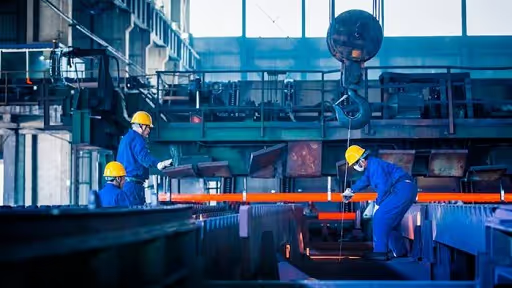
As manufacturers seek to build new products to introduce to the post-COVID market. Designs will need to be smarter and more efficient to lower costs and reduce rework that can waste limited supplies.
They must also achieve unprecedented functions in order to surpass competitors in their market and establish an undeniable demand for the product.
This requires engineers to analyze their product design to assess whether the components are too close together or difficult to place facing the same direction. If the location of the functional parts is too close to the battery or protrusion, if the fragility of the component is a potential problem, etc.
Their goal is to minimize operating time and costs, remove unnecessary materials that add weight, reinforce weak areas that can fail or cause a malfunction in the field, and other defects according to the specific design.
Here are some new approaches to consider:
* Find more issues in the EVT build. If you focus on getting the full catalog of problems. You will realize that certain design features create clusters of similar problems that can be better addressed through broader design changes.
* Works against the entire pareto. Most product groups are just trying to fix problems that obviously occur. That's usually not the most important or nefarious thing. Change your mindset to figure out every problem as soon as possible. Making more effort here (or implementing an optimization tool to do so) will save weeks by allocating resources to solve problems more efficiently, helping optimization in the manufacturing plant.
* Focus on traceability. Make sure you have the right data ahead of time, it will save you time later.
Supply chain optimization can be defined simply as operating the supply chain at the highest level of efficiency. Today, supply chain optimization also has a mark so that it operates at the highest level of efficiency and resilience.
Socio-economic pressures such as tariffs and changes in globalization have made these supply chains longer and spread out for more geographical reasons. The lesson of 2020 has shown us what optimization is really necessary.
As we rebuild supply chains to adapt to a post-pandemic future. Businesses will need to continue to look for better and more competitive suppliers to reduce costs.
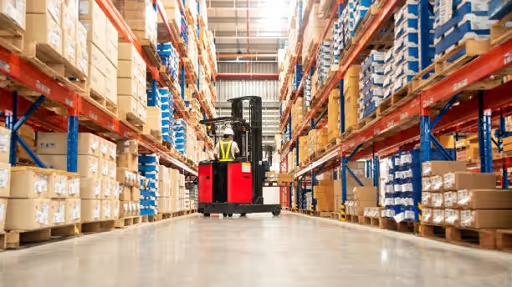
To make the supply chain more flexible, your business needs to be able to monitor the “health” state of the supply chain in real time, to eliminate the final consequences.
Geographical optimization (where different parts and assemblies are made compared to where they will be packaged or sold) will also be important. Because different countries will have different reactions to any future outbreak of the pandemic.
In a world full of chaos, the last thing anyone wants is to buy a product they trust. Apple survived the economic downturn thanks in large part to the trust it had placed in its brand.
They can introduce fundamentally different new products every year that don't seem to fail. They not only meet customer expectations. It also raises this level of expectation for most competing brands.
To perform optimization in production, contact us now for further advice.
Connect and experience positive transformations from our service to your business!

+84 (0) 82 599 4295

No.9, Alley 1 Lane 47 Doi Can Street, Ba Dinh District, Hanoi